Building More Financial Resilience at the Household Level

Intern Project: Smart Budget Bhutan (SBB)

QUICK ACCESS
Test Your Knowledge & Plan Your Budget
Take our 12-question financial literacy quiz or download the free SBB Planner to start budgeting today.

Why I Built the Smart Budget Bhutan (SBB) Platform

Financial resilience is not about how much you earn: it is about how well you manage what you have.

I am Jubita Gurung. During my third year at Gedu College of Business Studies, I completed a six-month internship at Bhutan Data Scientist Pvt. Ltd. (BDS), where I worked on a project focused on financial resilience at the household level in urban Bhutan.

Growing up and studying in Bhutan, I had personally experienced both the importance and the challenges of managing money wisely at a young age. As students, most of us did not have a regular source of income and relied on pocket money from our parents along with a small monthly stipend of around Nu. 2,500.

Like many others, I often ran out of money in the middle of the month. Even small needs of Nu. 100 or Nu. 200 became difficult to manage when my bank balance reached zero.

This experience inspired me to create the Smart Budget Bhutan (SBB) platform, designed to help students, employees, and individuals build stronger financial habits and make better financial decisions.

Through the SBB platform, I aimed to promote financial awareness by providing practical tools such as budget planner templates, basic budgeting methods, interactive quizzes, and simple learning resources.
Featured Story
Sonam's Story: From Stress to Financial Control

A 27-year-old in Thimphu had a job, a steady income and still couldn't save anything. Sound familiar? Read how she turned it around.

๐Ÿ“– Read Her Story โ†’

Financial Resilience Dashboard

Interactive Tableau Visualization

With the goal of understanding how urban Bhutanese households manage their finances, I designed a structured survey covering income sources, monthly expenses, saving habits, and financial stress points. Over the next 2 weeks, I reached out to as many people as I could across urban Bhutan and was able to collect 173 responses from real households.

You can view the full survey here โ†— to see exactly what questions were asked and how the data was structured.

With this data in hand, I built the Tableau dashboard below to turn those raw responses into clear, visual insights, exploring income distribution, monthly expense breakdowns, and savings behaviour across different income brackets. Use it to identify patterns, stress points, and opportunities for financial improvement in Bhutanese households. Filter by income group or expense category to drill deeper into the data. The findings behind this dashboard are documented in full โ€” read the complete project report here โ†—
Loading Dashboardโ€ฆ

Tip: Click on chart elements to filter and explore specific segments of the data.

The 50/30/20 Rule

A Simple Framework for Every Income Level

After analysing the survey responses, one of the clearest findings was that most households struggled not because they lacked income, but because they had no simple framework to guide how they spent and saved it. This told me that what people needed most was a straightforward, easy-to-remember budgeting rule they could apply immediately.

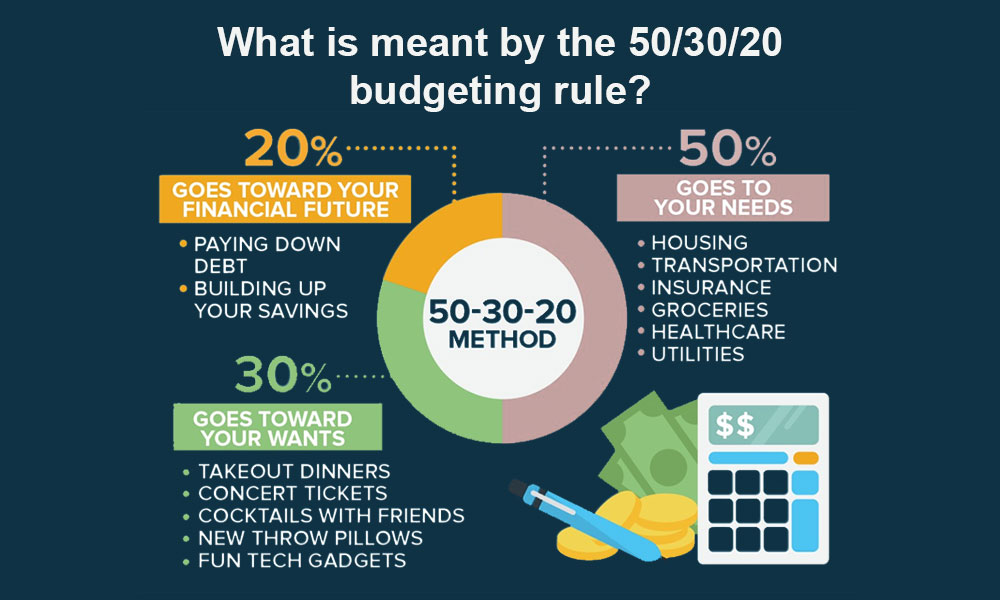
That is when I discovered the 50/30/20 rule a proven budgeting method that divides your monthly income into three clear categories: 50% for needs such as rent, food, and utilities, 30% for wants such as dining out and entertainment, and 20% for savings.

Recommended Framework: 50% Needs, 30% Wants, 20% Savings
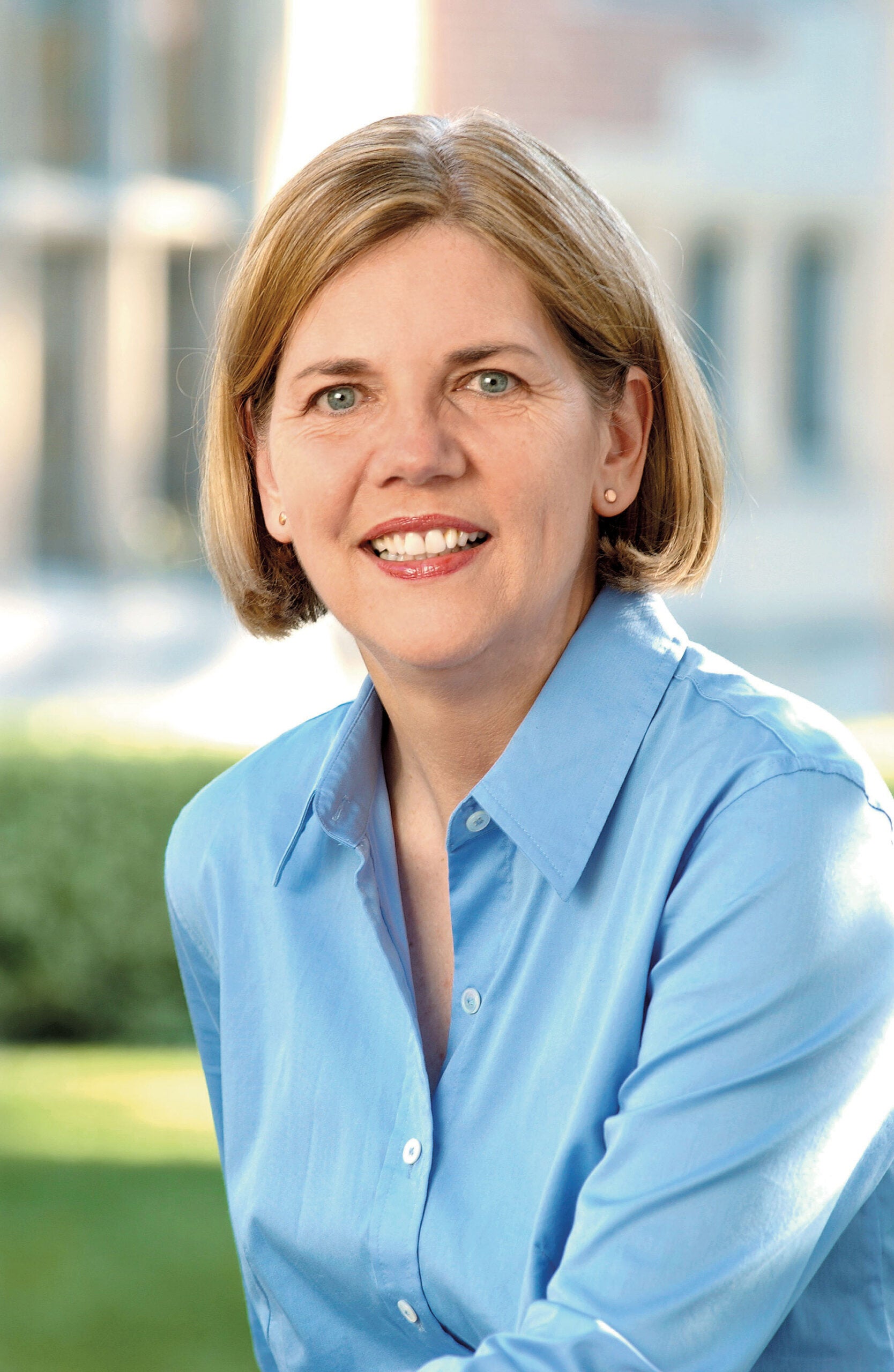
Elizabeth Warren
Founder
Elizabeth Warren
US Senator ยท Harvard Law Professor ยท Consumer Advocate

Elizabeth Warren now a US Senator from Massachusetts, first introduced the 50/30/20 rule in her 2005 book co-authored with her daughter Amelia Warren Tyagi. At the time, Warren was a Harvard bankruptcy law professor who had spent years studying why middle-class American families were going broke.

Her research found that people weren't failing because of overspending on luxuries they were failing because they had no framework to distinguish essential costs from optional ones. The 50/30/20 rule was her solution: a simple, memorable formula anyone could apply immediately.

Amelia Warren Tyagi
Co-author
Amelia Warren Tyagi
Business consultant ยท Daughter of Elizabeth Warren

Amelia Warren Tyagi co-authored the book with her mother, bringing a business strategy perspective to complement Elizabeth's legal and academic research. Together they translated years of bankruptcy data and household financial research into an accessible, practical guide.

Amelia's contribution was key in making the book readable for everyday families not just policymakers or academics. The book became a bestseller and the 50/30/20 rule became one of the most cited personal finance frameworks in the world.

All Your Worth book cover
All Your Worth: The Ultimate Lifetime Money Plan
Elizabeth Warren & Amelia Warren Tyagi ยท Published 2005

This is the book that introduced the 50/30/20 rule to the world. Warren and Tyagi argued that financial failure isn't a willpower problem it's a systems problem. Most people fail not because they buy too many coffees, but because they never build a structure to separate what they must spend, what they choose to spend, and what they keep.

The book reframes budgeting as a lifetime money plan not a monthly restriction. It became a foundational text in personal finance and is still widely recommended by financial advisors, universities, and consumer protection agencies worldwide. The rule it introduced has since been adopted by banks, budgeting apps, and financial educators globally including the framework used throughout this SBB platform.

Easy to remember
Three numbers. No spreadsheet required. Anyone can apply it from day one without financial training.
Works at any income
Whether you earn Nu. 15,000 or Nu. 150,000 a month, the percentages scale proportionally to your situation.
Builds resilience
The 20% savings cushion creates an emergency fund and long-term security the foundation of financial resilience.
Reduces guilt
By deliberately allocating 30% to wants, you can spend on enjoyment without guilt it's already planned for.
Research-backed
Born from years of bankruptcy research across thousands of real households not theory, but observed financial reality.
Globally adopted
Used by banks, apps like YNAB and Mint, and financial educators in over 50 countries including right here in Bhutan.
50/30/20 Budgeting Rule Explained

Budgeting Principles

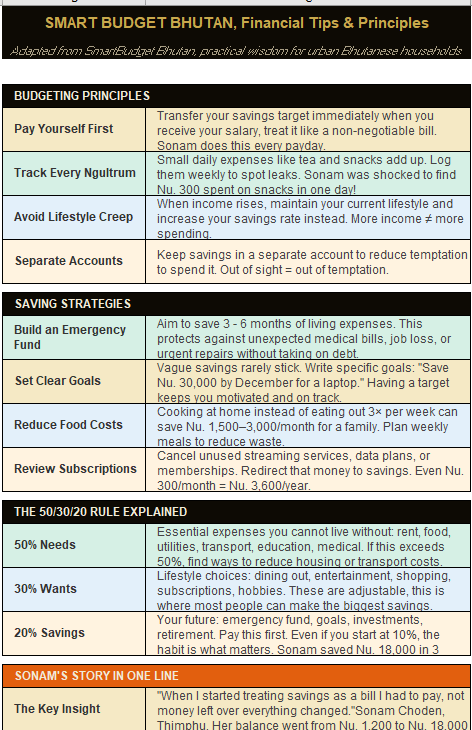
Pay Yourself FirstTransfer savings immediately when you receive your salary treat it like a non-negotiable bill.
Track Every NgultrumSmall daily expenses like tea and snacks add up. Log them weekly to spot leaks.
Avoid Lifestyle CreepWhen income rises, maintain your current lifestyle and increase savings rate instead.
Separate AccountsKeep savings in a separate account to reduce temptation to spend it.

SBB Planner

SBB Planner โ€” Free Download

As a student, I personally experienced running out of money before the end of the month. I created the SBB Planner so that other people don't have to go through that same stress. It is free, practical, and designed for real Bhutanese incomes.
Well done completing the quiz! Now let's turn your knowledge into action.
๐Ÿ“Š
SBB Planner
Full Excel workbook with 6 sheets: Cover, Budget Planner, Dashboard, Expense Tracker, Savings Goals, and Tips & Principles.
โฌ‡ Download Free
How to Use the SBB Planner
1
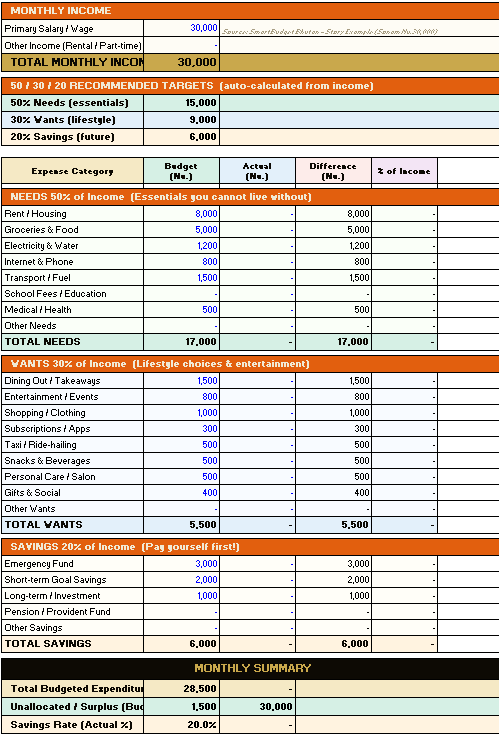
Budget Planner: Enter your monthly income in the blue cells and fill in budgeted amounts for Needs, Wants, and Savings.
2
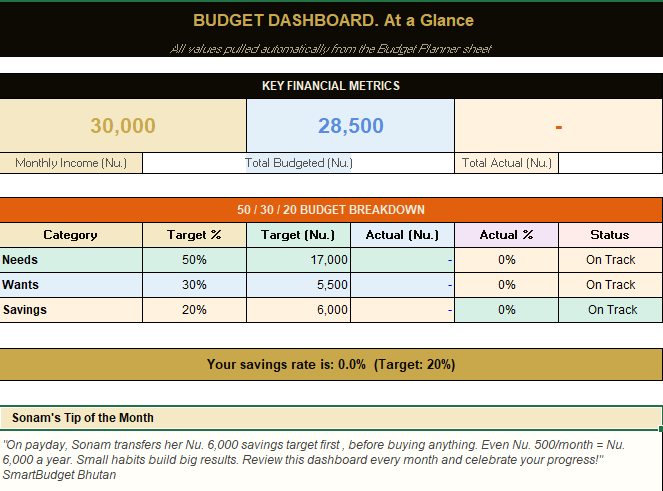
Dashboard: Review your 50/30/20 split at a glance. All values pull automatically from the Budget Planner sheet.
3
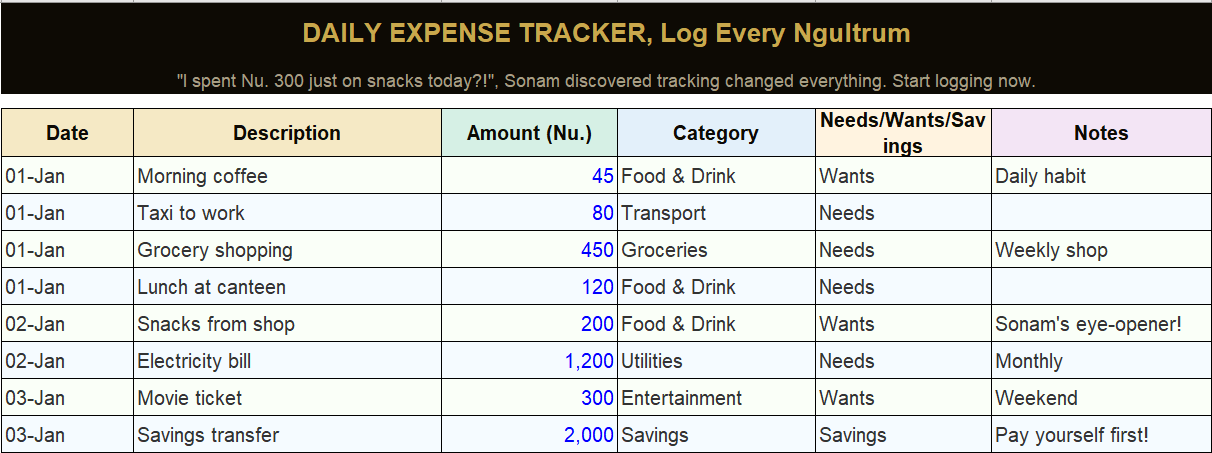
Expense Tracker: Log every daily expense with date, category, and Needs/Wants/Savings label.
4
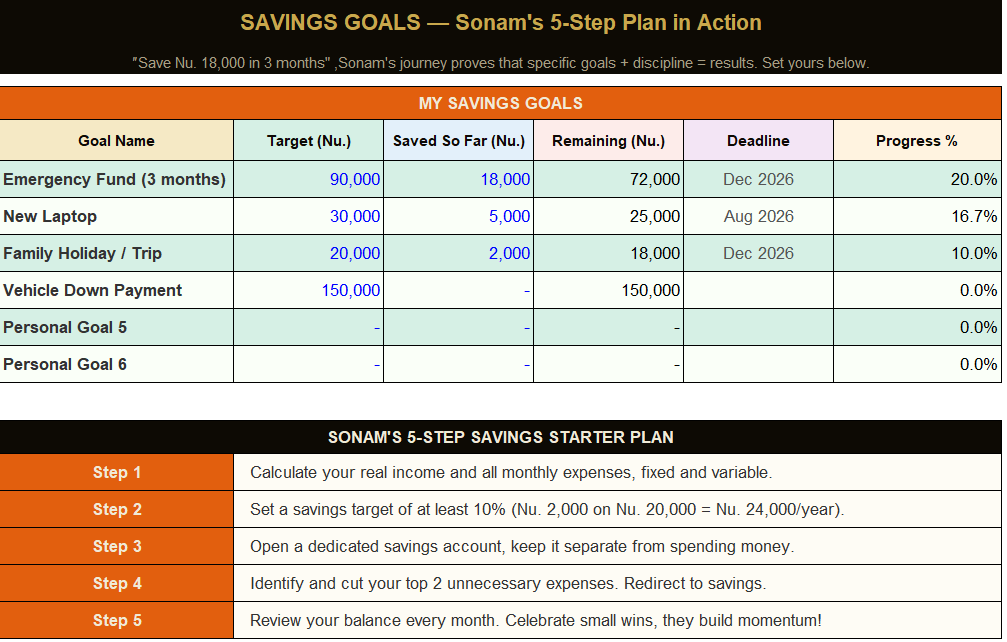
Savings Goals: Set specific goals with targets and deadlines. Track progress as you save.
5
Tips & Principles: Read Sonam's practical saving strategies adapted for Bhutanese households.
6
Review Monthly: At the end of each month, compare your budgeted amounts against your actual spending. Adjust next month's plan based on what you overspent or underspent.
7
Currency Converter: Need to check exchange rates? Head to the Tools section on this website for a live currency converter, useful when planning expenses across borders.
5-Step Savings Starter Plan
1
Calculate your real income and all monthly expenses, fixed and variable.
2
Set a savings target of at least 10% โ€” Nu. 20,000 = Nu. 2,000/month = Nu. 24,000/year.
3
Open a dedicated savings account, keep it separate from spending money.
4
Identify and cut your top 2 unnecessary expenses. Redirect to savings.
5
Review your balance every month. Celebrate small wins โ€” they build momentum!

What's Inside the SBB Planner: Sheet by Sheet

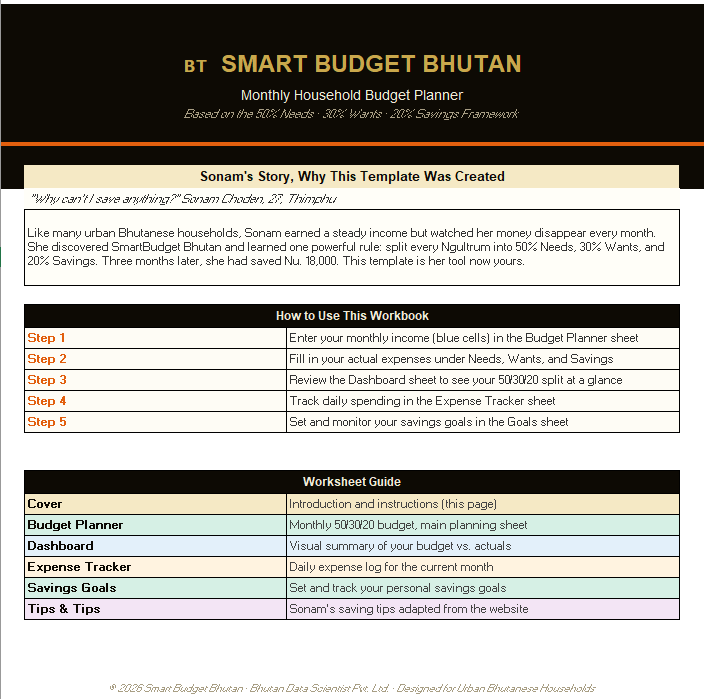
Cover Sheet
โคข
Cover
Introduction, Sonam's story, and step-by-step guide to using the workbook.
Budget Planner
โคข
Budget Planner
Main 50/30/20 sheet. Enter income, set budgets for Needs, Wants, and Savings.
Dashboard
โคข
Dashboard
Auto-calculated visual summary. See your budget vs. actuals at a glance.
Expense Tracker
โคข
Expense Tracker
Daily log for every Ngultrum spent date, category, and Needs/Wants/Savings tag.
Savings Goals
โคข
Savings Goals
Set targets with deadlines and watch your progress percentage grow automatically.
Tips & Principles
โคข
Tips & Principles
Sonam's practical saving strategies and the 50/30/20 rule for Bhutanese households.

Financial Literacy Quiz

Based on Real Survey Data from Urban Bhutanese Households

One of the most important findings from the survey was that many urban Bhutanese households were struggling financially not due to low income, but due to a lack of basic financial knowledge things like how to allocate income, what an emergency fund is, and how to avoid lifestyle creep.

That finding is exactly why I created this quiz. It is designed to help you test your own financial knowledge, learn something new from every question, and come back to try again as many times as you need. The more you practise, the stronger your financial resilience becomes.

The 12 questions below are drawn directly from real patterns and gaps identified in the survey data from urban Bhutanese households, including real-life scenarios you may recognise from your own life.

Question 1 of 12 Score: 0
QUESTION 1
0/8
CORRECT

Financial Tools

Currency Converter ยท Savings Calculator ยท 50/30/20 Calculator

Alongside the research and data work, I also built these three interactive financial tools as a hands-on exercise in JavaScript development. Building them from scratch taught me a great deal including how to fetch and handle live data from external APIs, how to validate and respond to user input dynamically, and how to build clean, interactive interfaces entirely through code. It was one of the most practical and rewarding parts of the whole project, and I hope you find the tools just as useful to use as they were educational to build.
๐Ÿ”„ Live Currency Converter
Convert between Bhutanese Ngultrum (Nu.), USD, and INR using live exchange rates.
Conversion Result
๐Ÿ’ฐ Savings Projection Calculator
Enter your monthly income and savings percentage to see how much you'll save over 1, 3, and 5 years.
Your Savings Projections
๐Ÿ“Š 50/30/20 Budget Calculator
Enter your monthly income and instantly see your 50% needs, 30% wants, and 20% savings split.
Your 50/30/20 Split
๐Ÿ  Needs (Rent, Food, Utilities) 50%
Nu. 0

๐ŸŽ‰ Wants (Entertainment, Dining) 30%
Nu. 0

๐Ÿ’š Savings (Emergency, Goals) 20%
Nu. 0

About This Project

Research ยท Data ยท Impact

Project Background

Smart Budget Bhutan (SBB) was developed as a research and data project at Bhutan Data Scientist Pvt. Ltd. (BDS), focused on understanding financial resilience at the household level in urban Bhutan.

The project analyses real household data collected from 173 urban households to understand income, expenses, savings behaviour, and financial stress points โ€” turning those insights into practical tools and resources that are accessible and actionable for everyone.

It includes a live Tableau dashboard, a free Excel budget planner, a 12-question financial literacy quiz, three interactive financial tools, Sonam's story, and a full standalone project report.

Objectives

  • Identify key financial challenges in urban Bhutanese households
  • Visualize income, expense, and saving patterns through a live Tableau dashboard
  • Provide practical, data-informed budgeting recommendations via the 50/30/20 framework
  • Promote long-term financial stability and resilience through the SBB Planner
  • Build financial knowledge through an interactive quiz and literacy resources
  • Make complex financial insights accessible to everyone through free tools and a project report

Tools & Technology

This project uses a modern data-to-web pipeline to turn raw household data into clear, actionable insights.

Data & Visualization

Tableau Data Analysis

Survey & Data Collection

Google Forms Google Sheets Google Docs

Website

HTML CSS JavaScript

Backend & API

Python Flask REST API

Budget Planner

Microsoft Excel 50/30/20 Framework

Deployment

Netlify Render.com

Trusted Savings & Investment Platforms in Bhutan

Explore verified financial institutions to start saving, investing, or planning your financial future.

Bank of Bhutan
Bank of Bhutan
Savings,Fixed Deposits,Loans

Bhutan's oldest and largest bank. Offers savings accounts (4.5% p.a.), fixed deposits from 91 days to 10 years, personal loans, home loans, and mobile banking via mBoB.

Visit Website โ†’
Bhutan National Bank
Savings,Recurring Deposits,Cards

A leading commercial bank offering savings accounts with no minimum balance, recurring deposits from Nu. 300/month, fixed deposits, internet & mobile banking via MPay.

Visit Website โ†’
Bhutan Development Bank
Rural Savings,Agriculture Loans,SME

Your development partner since 1988. Focused on rural and agricultural finance savings accounts, seasonal and business loans, and microfinance for small entrepreneurs.

Visit Website โ†’
T Bank
T Bank
Fixed Deposits,Recurring Savings,Loans

Offers high-return fixed deposit schemes from 45 days to 120 months, recurring deposit savings plans for salaried employees, and competitive interest rates for long-term savers.

Visit Website โ†’
Druk PNB Bank
Druk PNB Bank
Savings,Personal Loans,NRI Banking

A joint-venture commercial bank offering personal savings, fixed deposits, consumer loans, and banking services for Bhutanese citizens and NRIs through digital platforms.

Visit Website โ†’
NPPF
NPPF
Pension,Provident Fund,Housing Loans

National Pension & Provident Fund manages retirement savings for civil servants and private sector employees. Offers pension (Tier I) and provident fund (Tier II) benefits plus housing loans.

Visit Website โ†’
Royal Securities Exchange of Bhutan
Stock Market,Listed Companies,Equity

Bhutan's official stock exchange established in 1993. With 19 listed companies and ~$738M market cap, it's the gateway for Bhutanese citizens to invest in local equities.

Visit Website โ†’
DK Bank
DK Bank (Digital Kidu)
Digital Banking,Cardless,Inclusive

Bhutan's first digital-first bank. Offers simplified savings accounts, cardless withdrawals, and modern banking services designed for easy access for all Bhutanese citizens.

Visit Website โ†’
All institutions above are regulated by the Royal Monetary Authority (RMA) of Bhutan. Always verify current interest rates and products directly on their official websites.

Contact Info

Get In Touch ๐Ÿ“ž

Have questions about this project or want to collaborate? Reach out directly.
Project Creator
Jubita Gurung
๐Ÿ“ Gedu College of Business Studies, Bhutan
Host Organization
Bhutan DataScientist Pvt. Ltd.
๐Ÿ“ Thimphu, Bhutan
โœ‰๏ธ info@datascientists.com